- We are launching an international design competition
- Triple Crisis — Triple Answer
- The Sun Isn’t to Blame
- What We Propose
- 1. The Purpose
- 2. Endothermic Technologies We propose implementing endothermic materials —that absorb energy instead of releasing it. For example:
- 3. Solar Panels and Urban Rewilding Solar panels aren’t just for rooftops.They can be installed:
- 2. Endothermic Technologies
- 3. Solar Panels and Urban Rewilding
- How the System Works
- 1. Electricity and CO₂ Capture
- 2. CO₂ Processing and Heat Recovery
- 3. Condensate and Plant Hydration
- 4. Heating and Efficiency
- 5. Winter Reserves
- 6. Creating a Closed Fuel Cycle
- 7. Green Infrastructure Under Panels
- 8. Quiet and Comfort in Public Spaces
- 9. Nighttime Air Renewal
- Call for Partners and Contributors
Air-to-City Fuel is a radical new concept that transforms cities into clean fuel producers — using sunlight, air, and advanced architecture.
Imagine a city that no longer burns fossil fuels,
but generates its own carbon-neutral fuel from rooftops, streets, and public spaces.
A city that not only powers itself,
but cools the climate, purifies the air, and brings water back to life.
This is not science fiction.
This is real.
This is Air-to-City Fuel — a thermodynamic, ecological, and architectural system that’s ready to change the world.

We are launching an international design competition
We are launching an international design competition to build the first real-world prototype in Kharkiv, Ukraine —
a city under attack that chooses innovation over despair, and reconstruction over revenge.
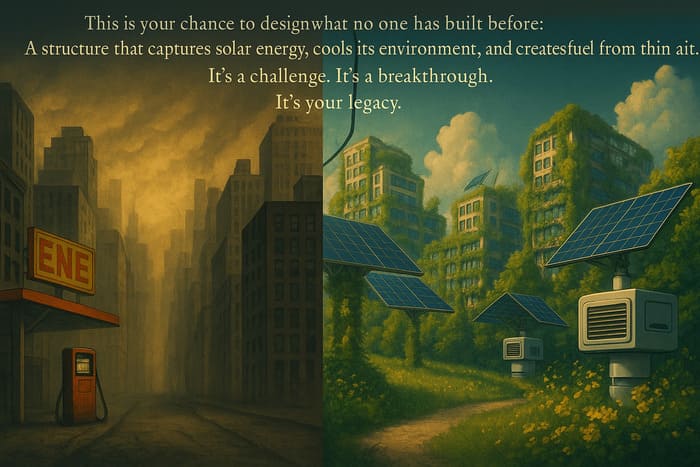
This is your chance to design what no one has built before:
A structure that captures solar energy, cools its environment, and creates fuel from thin air.
It’s a challenge.
It’s a breakthrough.
It’s your legacy.
Because architecture isn’t just about aesthetics.
It’s the only force powerful enough to make the invisible visible,
to turn formulas into form, and visions into reality.
And once people see it — they’ll want it everywhere.
Air-to-City Fuel needs a shape. It needs you to build it.
Triple Crisis — Triple Answer
The energy, climate, and military crises share a common root:the struggle for resources.Cities — especially Kharkiv — stand at the frontline.
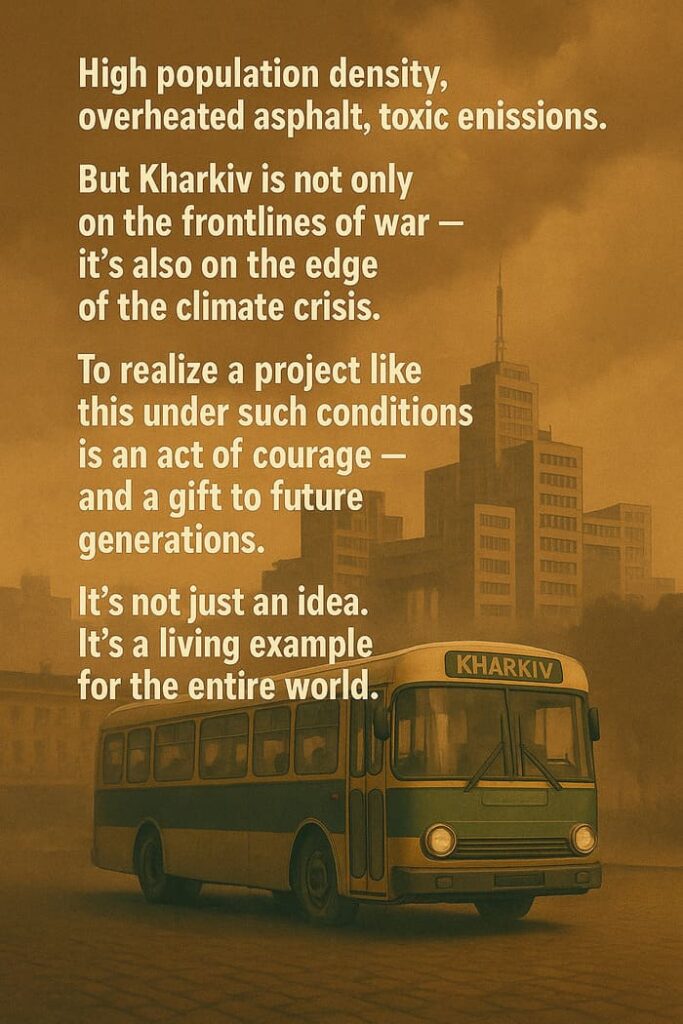
High population density, overheated asphalt, toxic emissions.But Kharkiv is not only on the frontlines of war —it’s also on the edge of the climate crisis.To realize a project like this under such conditions is an act of courage —and a gift to future generations.It’s not just an idea. It’s a living example for the entire world.
The Sun Isn’t to Blame
It doesn’t choose where to shine.But we — humans — have paved over the Earth’s surface,eliminating the natural areas that once absorbed sunlight through grass and leaves.Concrete, asphalt, stone — they aren’t plants.They don’t cool the air. They don’t evaporate moisture.They simply absorb heat.As a result, sunlight falling on developed surfaces no longer powers life —it creates a desert effect.This doesn’t just alter the city’s microclimate —it adds thermal pressure to surrounding regions.Cities overheat themselves — and everything around them.This is no longer a hypothesis.This is Kharkiv’s reality:
• decreasing rainfall,• dying rivers like the Kharkiv and Lopan,
• and worst of all — the slow collapse of the Siverskyi Donets,which supplies water to the entire city.
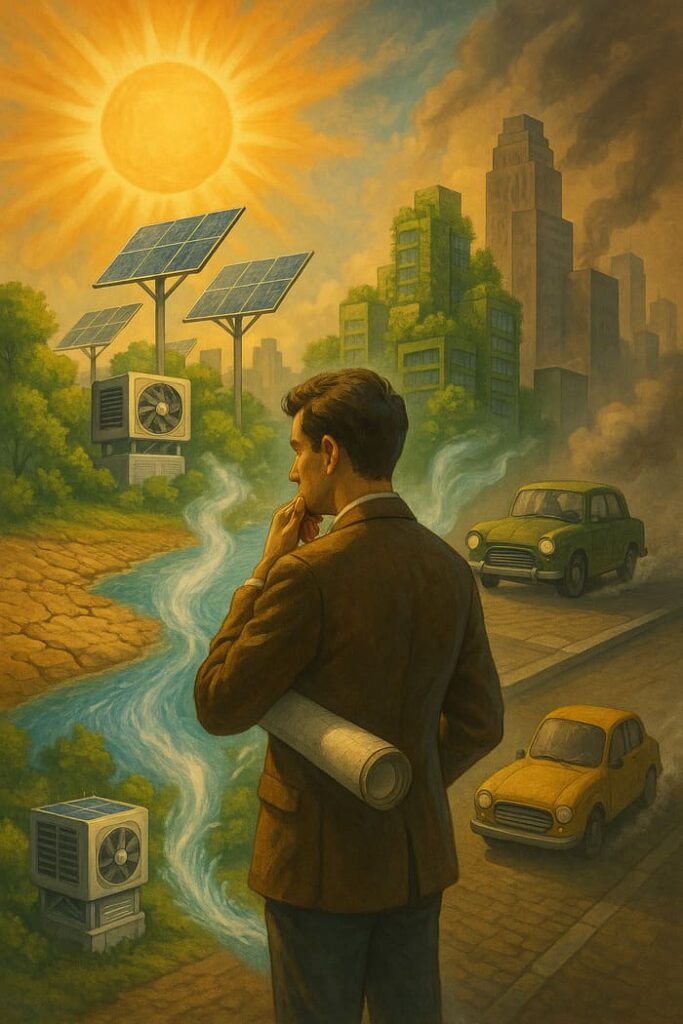
And yes — the sun plays a role.But only because we didn’t let it work differently.The sun gives us energy.And we still have a chance to make that energy work —not for destruction, but for restoration.We can harvest it.We can cool the city.We can bring back water. And we can create clean, carbon-neutral fuel from the air —fuel that cities can use to power homes, vehicles, and entire districts.Not fossil fuel. Not imported fuel. Fuel made from sunlight, CO₂, and water.
If not us — then who?
No one but us.
What We Propose
Building a Closed-Loop System of Energy, CO₂, and WaterWe propose creating a fully closed cycle —where carbon dioxide becomes fuel,sunlight becomes power,and water becomes part of the solution.This is Air-to-City Fuel in action.
1. The Purpose
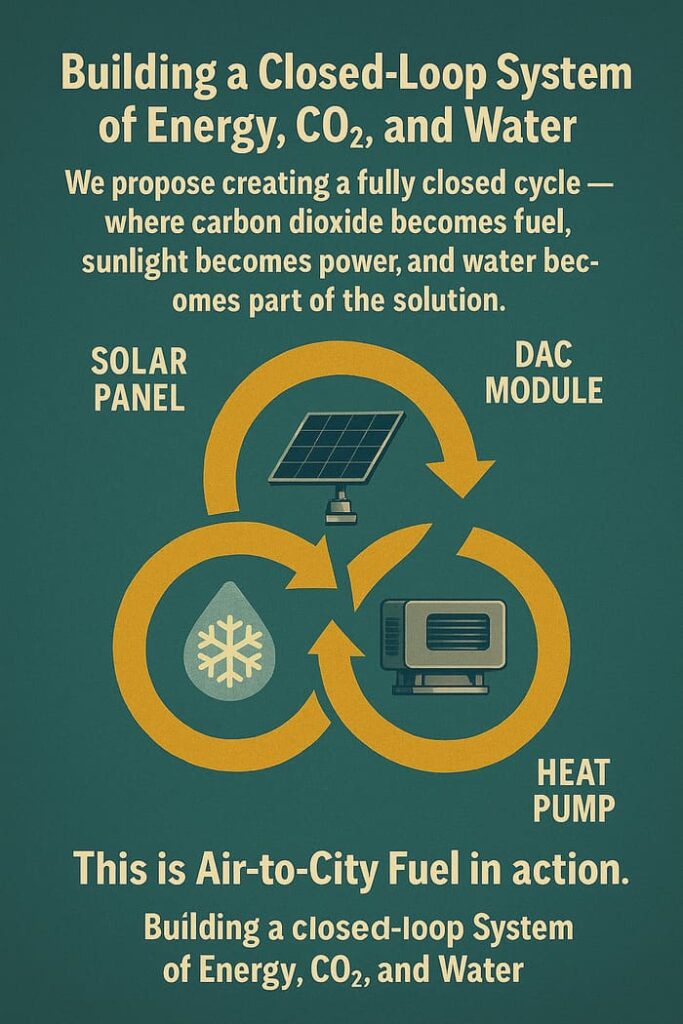
• Capture CO₂ directly from streets — near traffic, malls, and bus stops.
• Convert that CO₂ into liquid fuel (ethanol, methanol) using solar-powered systems.• Use the heat from the CO₂ liquefaction process for hot water and building heating
.• Collect water from condensation to reuse in fuel production.
• Apply this fuel not just for transportation (preserving internal combustion engines),but for heating, industry, and local energy needs.We are not just replacing fuel —we are redefining where fuel comes from.Not from the ground. Not from conflict.But from the air above us and the sun that shines on every street.
2. Endothermic Technologies We propose implementing endothermic materials —that absorb energy instead of releasing it. For example:
• glass with a negative thermal footprint,
• used in solar panels, windows, and mineral wool insulation.These materials don’t just reduce heat.They turn architecture into a climate stabilizer —and help fuel creation systems work more efficiently.
3. Solar Panels and Urban Rewilding Solar panels aren’t just for rooftops.They can be installed:
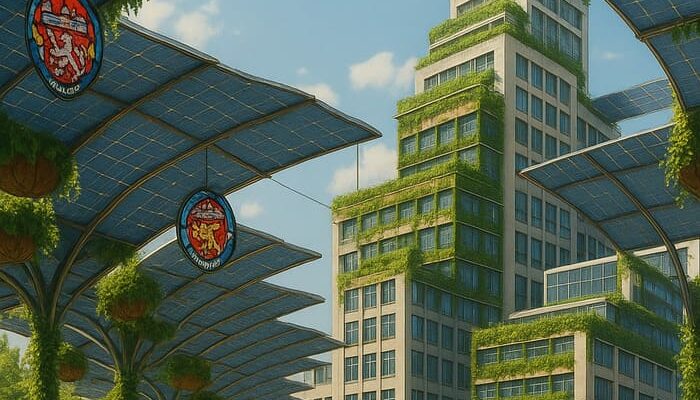
• above pedestrian zones, streets, and bridges,
• on rooftops, public squares, parking lots, and transit stops.Beneath them — green zones, vertical gardens, and moisture-retaining plants.This isn’t just energy.This is urban climate reversal — replacing heat traps with climate-active surfaces,and shifting from fossil energy to regenerative fuel ecosystems.The glass in these panels is not passive.It actively cools the air — both during manufacturing and use. Beneath these canopies:
• shade-loving plants thrive in microclimates,
• sidewalks are divided by green barriers,
• moisture returns to the city cycle.
This creates a dual climate effect:
• panels absorb and reflect excess heat,
• while vegetation restores moisture and cleans the air.
Together, they make cities cooler, greener, and fuel-generating.
2. Endothermic Technologies
We propose implementing endothermic materials —that absorb energy instead of releasing it.
For example:
• glass with a negative thermal footprint,
• used in solar panels, windows, and mineral wool insulation.
These materials don’t just reduce heat.They turn architecture into a climate stabilizer —and help fuel creation systems work more efficiently.
3. Solar Panels and Urban Rewilding
Solar panels aren’t just for rooftops.They can be installed:
• above pedestrian zones, streets, and bridges,
• on rooftops, public squares, parking lots, and transit stops.Beneath them — green zones, vertical gardens, and moisture-retaining plants.This isn’t just energy.This is urban climate reversal — replacing heat traps with climate-active surfaces,and shifting from fossil energy to regenerative fuel ecosystems.The glass in these panels is not passive. It actively cools the air — both during manufacturing and use.Beneath these canopies:
• shade-loving plants thrive in microclimates,
• sidewalks are divided by green barriers,
• moisture returns to the city cycle.
This creates a dual climate effect:
• panels absorb and reflect excess heat,
• while vegetation restores moisture and cleans the air.Together, they make cities cooler, greener, and fuel-generating.
How the System Works
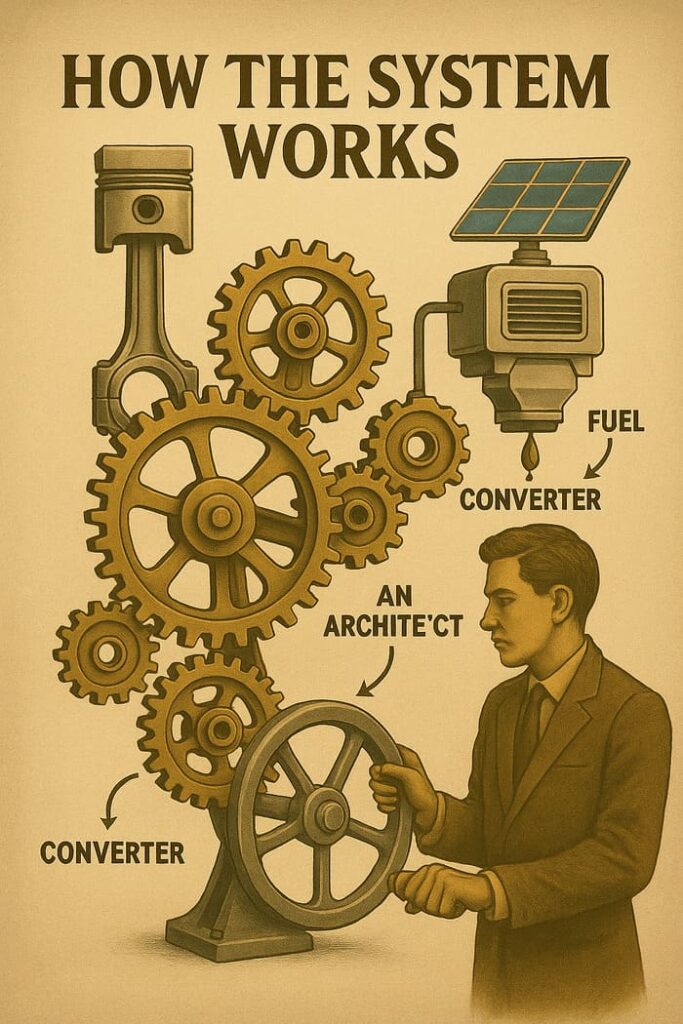
1. Electricity and CO₂ Capture
• Solar panels generate electricity for the entire city.
• DAC modules (Direct Air Capture) extract CO₂ directly from the atmosphere.
• Panels simultaneously cool the air and produce clean power.
2. CO₂ Processing and Heat Recovery
• Captured CO₂ is liquefied.
• The heat released during liquefaction is reused for domestic hot water and heating.
• The liquefied CO₂ is transported out of the city for further processing.
• Heat pumps produce water condensate during CO₂ liquefaction.
3. Condensate and Plant Hydration
• Water vapor from engines increases urban humidity, supporting plant growth.
• The collected condensate is reused in synthetic fuel production.
4. Heating and Efficiency
• Energy-efficient buildings are heated via air-to-water heat pumps powered by solar energy or fuel-derived generators.
• Additional electricity is supplied by CHP plants running on Air-to-City Fuel.
• These plants are upgraded with CO₂ and water recovery systems and can be located outside the city.
5. Winter Reserves
• In winter, local CHP plants use stored fuel to supply electricity, including for public transport.
• Most fuel is produced in summer and stored for later use.
6. Creating a Closed Fuel Cycle
• Fuel is synthesized from captured CO₂, solar energy, and re?claimed water.
• This clean fuel powers not only transportation (including diesel engines) but also heating, production, lighting, and comfort systems.
7. Green Infrastructure Under Panels
• Under solar panels, green zones absorb heat and improve the microclimate.
• Solar light tubes with negative-thermal-footprint glass provide soft, natural lighting.
8. Quiet and Comfort in Public Spaces
• Reflective layers concentrate sunlight through vegetation and panels, creating bright yet gentle shade.
• This reduces noise levels in pedestrian areas, enhancing comfort.
9. Nighttime Air Renewal
• Even at night, DAC modules continue CO₂ capture, refreshing urban air — ideal for outdoor cafes or shaded green pavilions.
Call for Partners and Contributors

To make this vision a reality, we invite designers, architects, manufacturers, innovators, investors, and decision-makers to join the first circle of pioneers.
We are currently seeking:
• Architects and design studios ready to participate in the international competition and define the first forms of Air-to-City Fuel.
• Judges and advisors to join the independent panel evaluating proposals based on climate impact, feasibility, and innovation.
• Manufacturers of solar panels, DAC (Direct Air Capture) modules, heat pumps, and thermal glass — who want to see their products implemented in a transformative prototype.
• Technology providers capable of water electrolysis, hydrogen/oxygen generation, and high-temperature solar chemistry.
• Synthetic fuel companies with experience in producing ethanol, methanol, or other climate-neutral fuels.
• Automotive, aerospace, and marine vehicle manufacturers interested in clean fuel applications for internal combustion engines.
• Public transport companies and operators seeking to pilot next-generation vehicles.
• Green energy startups and infrastructure investors interested in high-visibility deployment.
• Banks, climate funds, city agencies, and sponsors willing to support the pilot financially and reputationally.
Air-to-City Fuel is not just a concept. It is a platform. It is a movement.
This project is a key to the future of life on this planet.
And the first step is building the team that will make it happen.
If you are interested in becoming a partner, jury member, sponsor, or provider: 📧 Please contact us at papapatent2020@gmail.com
You can also use the comment field below or find the contact link in the page header.
This project will only be officially launched when a dedicated team is formed — one that is ready to take the first step and carry this idea forward.